A Project of


 Thinking Pakistan's History
With the imminent departure of the British, steps were taken to decide the fate of India post-independence.
Last Updated: 16 Sep. 2014
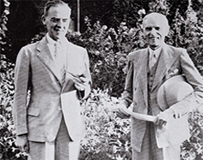
During World War II, the British had suffered some major setbacks. In India Gandhi had stepped up the civil disobedience campaign in an effort to pressure the British into granting India independence. Due to the threat posed by Japan, the British wanted persuade the Congress leadership to support the war effort. In 1942, Britain sent Sir Stafford Cripps with constitutional proposals that would give the Indian Union full dominion status after the war. A clause that the provinces could opt out of the future federation did not sit well with the Congress Party and did not sufficiently address the demands of the Muslim League either. Thus it was rejected by both parties.
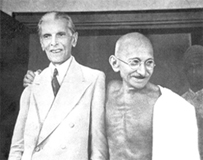
The Gandhi-Jinnah talks began in Bombay on 9 September 1944 and lasted until 27 September the purpose of which was to discuss communal affairs after the departure of the British. Although the talks failed to reach any clear agreement, they did result in political gains in that the Congress for the first time met with the League on equal footing.
As World War II came to an end, Britain was keen to negotiate a transfer of power within India so that it could concentrate on domestic affairs. In June 1945, the Viceroy, Lord Wavell, proposed a plan of action in which an Executive Council would be constituted to act as the interim government. The Council was to be Indian except for the Viceroy and the defense member and there would be equal representation of Muslims and Hindus. All political parties were invited to Simla to discuss the plan. A debate ensued on the selection of the Council members with the Congress arguing that they had the right to nominate Muslims whereas the Muslim League argued they should have sole right. No consensus was reached on this issue.
In 1945-46 elections were held in which the Congress won the majority of non-Muslim votes and the Muslim League won the majority of Muslim votes. This win validated the point that League was indeed the voice of Muslims in India and that they supported the League’s bid for a separate homeland.

All of the British Government’s attempts to establish peace between the Congress and the Muslim League had failed. The results of the general elections held in 1945 – 46 served to underline the urgency to find a solution to the political deadlock, which was the result of non-cooperation between the two major parties. To end this, the British government sent a special mission of three senior cabinet ministers to India. It was a last attempt to keep the subcontinent together as a federation after independence. The mission arrived in March 1946. After extensive discussions with Congress and the Muslim League, the Cabinet Mission put forward its own proposals on 16 May 1946.
The main points of the plan were:
Subcontinent would be divided into three groups: Muslim majority provinces of Sindh, Punjab and NWFP would comprise one group, Bengal and Assam a second group and Hindu majority provinces a third group;
These groups would have a great deal of autonomy and frame their own constitutions;
There would be a central government in Delhi that would deal with foreign affairs, defense and communications;
There would also be an interim government having the support of the major political parties.
Although the Muslim League was not happy with the proposal it was willing to participate in the interim government. But in July 1946 Nehru said that after independence a future Indian government would not necessarily feel bound by the Cabinet Mission Plan. This served as a final blow to any chance of the plan being accepted and the League retracted its support.
The Muslim League feared that the British were prepared to sacrifice Muslim interests in their haste to leave the subcontinent. They did not participate in making nominations for the Executive Council for interim government due to their previous objections over who could nominate Muslims to it. However, Wavell was able to convince the League that staying out of the Council was not the solution either. So eventually Jinnah made 5 nominations to the Council.
Cabinet Mission Plan: Statement by the Cabinet Delegation and the Viceroy as issued in New Delhi on 16 May 1946.
Bajwa, Farooq N. “Towards Pakistan.” Pakistan: A Historical and Contemporary Look. Revised ed. Karachi: Oxford UP, 2002.
Ziring, Lawrence. “The Origins of Pakistan.” Pakistan: At the Crosscurrent of History. Lahore: Vanguard, 2004.
“British Raj.” Wikipedia. Wikimedia Foundation, 14 Nov. 2013.

