A Project of


 Thinking Pakistan's History
India’s first War of Independence, an uprising against British rule in India, served as a major turning point in the history of the subcontinent.
Last Updated: 16 Nov. 2013
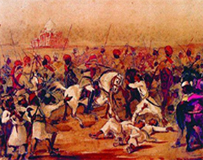
India’s First War of Independence (1857-58), also referred to as the Sepoy Mutiny, Uprising of 1857 or Great Rebellion, was an uprising against British rule in India, which had its roots in a variety of political, social, economic and religious factors that had built up over time. A few specific areas such as Meerut, Delhi, Kanpur, Lucknow and Jhansi were the centers of resistance. The resistance disintegrated primarily due to lack of leadership and unity on the part of the Indians. It was a remarkable event in Indian history, marking the formal start of the British Raj in India as well as the initial stirrings of the struggle for independence from colonialism.
The War of Independence broke out due to a variety of factors some longstanding and some more immediate. One important cause was the Doctrine of Lapse introduced in 1852, under which the British could take over kingdoms that did not have a direct male heir. The Governor General, Lord Dalhousie, was able to annex several prominent states such as Awadh using this doctrine. Then there were reforms such as replacement of Sanskrit and Persian with English as the language of official use in 1834 and the abolishment of sati, which along with the work of missionaries lead to fears that social and religious values were under threat.
Disgruntlement amongst the Bengal Army, which was recruited from Northern India particularly Awadh, also formed a basis for the uprising. As the East India Company expanded its territory, soldiers from the Bengal Army were now expected to serve in far-away territories or overseas, something that they were previously exempted from due to religious reasons. There were also issues related to the basis for promotion and low salary that served as causes for discontent in army.
The immediate cause of the war was the introduction of the Enfield rifle in January 1857 which used greased cartridges apparently coated in cow and pig fat that lead to dissent amongst the Indian troops. The British eventually sought to recall the cartridges but it was too late, as troop uprisings had already begun.
In March 1857 in Bengal a sepoy called Mangal Pandey refused to use the cartridges, revolted against his commanding officers and was later executed. In April 1857 in Meerut, sepoys refusing to use the cartridges were sentenced to 10 years imprisonment; this sparked the first uprising in May. From there the uprising spread to Delhi, Lucknow, Kanpur (Cawnpore) and Jhansi with British losing control in a matter of weeks. In Delhi the Bahadur Shah Zafar, the last Mughal Emperor, was installed as ruler. In Kanpur an uprising led by Nana Sahib captured the town. Rani Laxmibai of Jhansi, who fought to defend Jhansi, later captured Gwalior and fought valiantly till her death. The Siege of Delhi lasted from July to September 1857 and for a while it seemed as though the rebels would force the British to withdraw, however the British forces were able to prevail and recapture the city. By the end of the 1857 the British began to recapture cities, in March 1858 it recaptured Lucknow and on 8 July 1858 a peace treaty was signed ending the uprising.

The uprising failed due to lack of leadership and unity on the part of the Indians. Many important Nawabs did not join the uprising and there was also a lack of a common cause amongst those involved. As a result of the uprising, the British Government sought to establish direct rule in India. In 1858 the Parliament transferred the rights of the East India Company to the British Crown. The new administration included a British Secretary of State, a viceroy (in place of governor general) and an advisory council. In 1877 Queen Victoria of England was declared Empress of India.
Bajwa, Farooq N. “The Rise of Muslim Nationalism.” Pakistan: A Historical and Contemporary Look. Revised ed. Karachi: Oxford UP, 2002.
Marshall, Peter. “British India and the Great Rebellion.” BBC History. BBC, 17 Feb. 2011.
Patel, Nilesh. “Sepoy Mutiny of 1857.” Postcolonial Studies @ Emory. Emory University, June 2012.
“Indian Mutiny.” Encyclopedia Britannica Online. Encyclopedia Britannica, 2010.
BBC Radio: This Sceptred Isle (A 90 part history of the British Empire) – Episode 49 – Origins of the Indian Mutiny; Episode 50 – Sepoy Rebellion I; Episode 51 – Sepoy Rebellion II and Episode 52 – End of Mutiny
PBS The Story of India: Episode 6 – Great Rebellion of 1857 (video)

