A Project of


 Thinking Pakistan's History
An important region for many centuries, Gandhara was the center of civilization and culture.
Last Updated: 28 Feb. 2014
Gandhara was a historical region located mainly in the area of the Peshawar Valley, Potohar Plateau and Kabul River Valley. The civilization lasted from the 1st century BC into the 11th century AD. Its main cities were Purushapura (Peshawar), Pushkalavati (Charsadda) and Takshashila (Taxila).
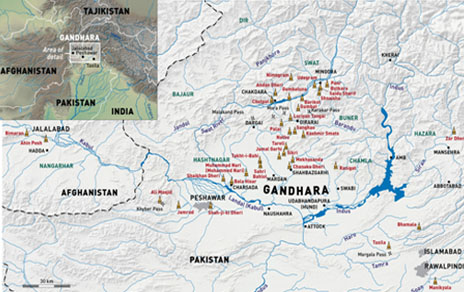
Gandhara is mentioned as far back as the Vedic Age where it plays a role in the epics of Ramayana and Mahabharata. However it is after the Persian invasion by Cyrus the Great in 530 BC, when it became the easternmost province of the Achaemenid Empire of Persia, that it rose to power in the region. Under the reign of Cyrus and Darius I, the use of coin currency and iron tools were introduced for the first time. The most significant development was the establishment of a university at Taxila, one of the oldest universities in the world. After 380 BC, Persian hold on the region weakened and Gandhara was broken in to small kingdoms.
Gandhara was then conquered by Alexander the Great when he invaded the subcontinent around 327 BC. Shortly thereafter it passed onto Chandragupta Maurya. Under the Mauryan Dynasty it became the center for the spread of Buddhism. After the Mauryans, Gandhara was ruled by various invaders – Greeks, Sakas, Scythians – who passed through the subcontinent. Under the Buddhist Kushan Kings, from the 1st to 5th century AD, Gandhara reached its peak. The last king, Jayapala expanded the kingdom from west of Kabul to the River Sutlej. However after his defeat by the Ghaznavids, Gandhara began to decline.
Gandhara, due to its strategic location, was the locus for Indian-Persian interaction and a major hub for trade. It was also an important communication channel with Ancient Iran and Central Asia. Its two cities, Pushkalavati and Takshashila, were the center of civilization and culture.

Gandhara is famous for its distinctive art style which is a mixture of Greek, Syrian, Persian, and Indian influences. The Gandharan style flourished during the Kushan period. It sought to depict different Buddhist concepts through sculptures, rock carvings and petroglyphs. Over 1,400 such pieces are now housed in the Taxila Museum and some are still found along the ancient Silk Road (Karakoram Highway).
Gandharan Buddhist Scroll: One of the oldest South Asian texts dating back to the 1st century AD.
Lendering, Jona. “Gandara.” Livius: Articles on Ancient History.
Behrendt, Kurt. “Gandhara.” Heilbrunn Timeline of Art History. Metropolitan Museum of Art, 2000.
Asia Society: The Buddhist Heritage of Pakistan – Art of Gandhara

